meaning.card_of_day

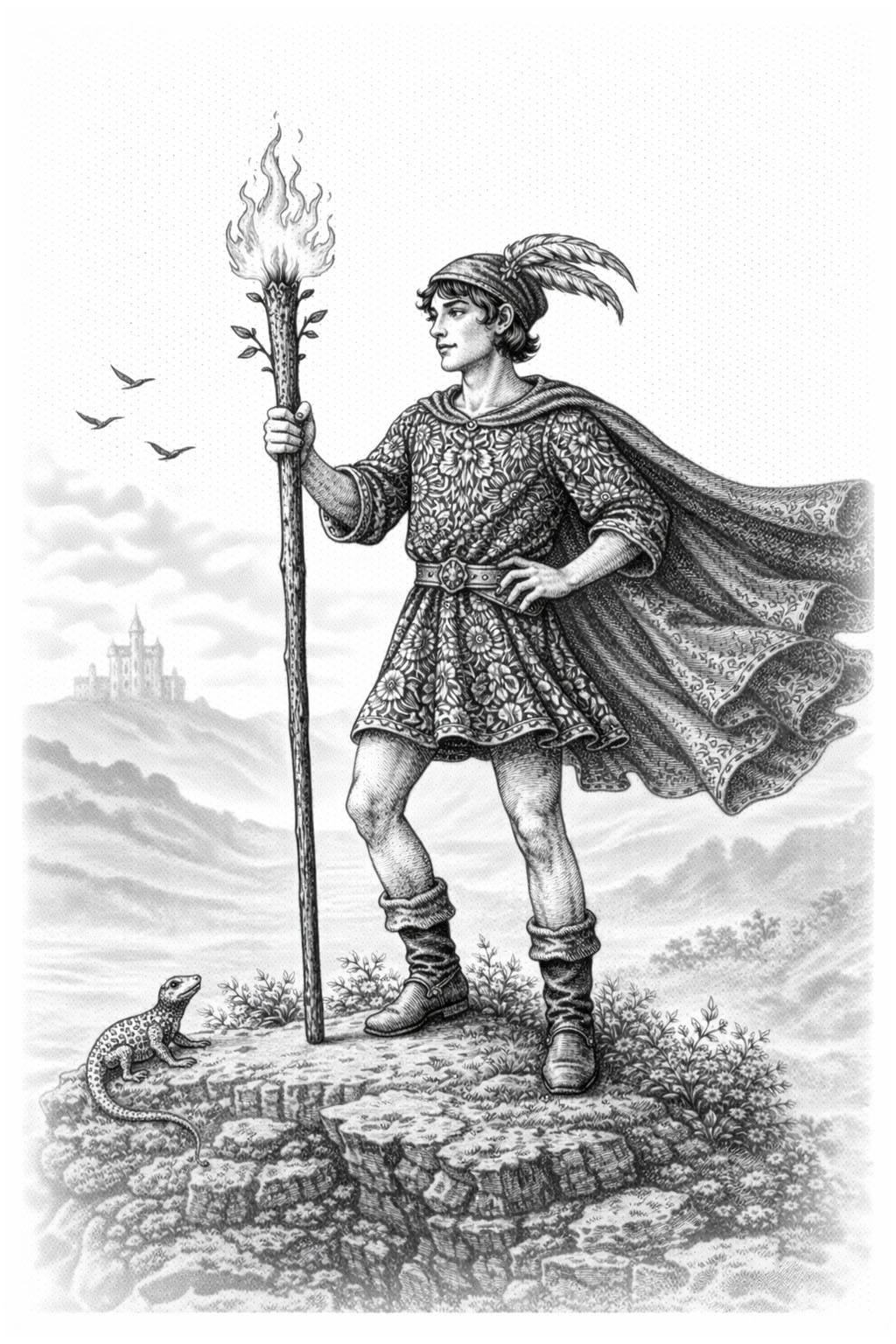
The Page of Wands belongs to the suit associated with fire: energy, creativity, initiative and curiosity. As a court card it represents a youthful or fledgling expression of those qualities — an exploratory impulse, an incoming idea or message, and the readiness to test possibilities. Imagery traditionally shows someone poised to set out rather than arrive, emphasizing potential and the first spark of action rather than mastery. As a card of the day, it highlights an atmosphere in which experimentation and fresh interest are prominent. It points to moments when new information, an invitation to try something different, or a sudden creative impulse catches attention. The card suggests openness to learning by doing; small, enthusiastic steps and quick sketches of ideas are more characteristic than finished plans. Communication may be lively and optimistic, and practical results are less important than momentum and discovery. Consider also the card’s less developed aspects: enthusiasm can turn into restlessness, ideas may be half-formed, and a tendency to jump in without preparation can scatter attention. From an analytical perspective, the Page of Wands invites noticing where energy is abundant but structure is thin, and encourages balancing curiosity with a little planning and follow-through. It is useful for reflecting on what one wants to explore further, what questions remain unanswered, and how to channel initial excitement into concrete, learnable steps.

Wands Page

meaning.forward

When the Page of Wands appears upright, it represents the emergence of creative energy, curiosity, and a readiness to explore new possibilities. As a youthful, elemental figure of fire, this card points to the initial spark of inspiration rather than its mature expression: enthusiasm, experimental impulse, and a willingness to take the first steps toward a project or interest. The Page functions as a learner or messenger, signaling that ideas and opportunities are arriving in a raw, malleable form that invites investigation and play. Symbolically, the card emphasizes movement, potential, and communication. It highlights qualities such as openness to novelty, courage to try things without full mastery, and an appetite for learning through experience. In practical terms, its appearance can indicate that a situation is at an early stage and that exploration, trial-and-error, and information-gathering will be more important than polished expertise or long-term planning. It also points to messages or prompts that ignite enthusiasm—an invitation, a new contact, or a youthful perspective that reframes a problem. A balanced interpretation recognizes both strengths and limitations. The Page’s optimism and spontaneity are useful for breaking stalemates and initiating momentum, but they can also manifest as impatience, inconsistency, or a superficial engagement with complex issues. Working constructively with this energy involves cultivating curiosity while remaining mindful of follow-through and the need to deepen skills if a nascent idea is to develop sustainably. In readings focused on work, creativity, relationships, or study, the Page of Wands can be read as a sign that a fresh approach or experiment is appropriate; it points to beginnings rather than conclusions and encourages active exploration. As an educational archetype, it invites asking questions, seeking mentors, testing hypotheses, and embracing small, iterative steps to see what resonates and what endures.

meaning.reverse

The reversed Wands Page describes a youthful, restless energy that is misdirected, blocked, or underdeveloped. Instead of the open enthusiasm and exploratory impulse associated with the upright card, the reversed position highlights hesitation, inconsistent follow-through, and a tendency toward half-formed ideas that never fully materialize. Psychologically, it can point to fear of failure, perfectionism that prevents starting, or a fragile confidence that alternates with impulsivity and discouragement. In communication and learning contexts this card often signals unreliable messaging, immature expression, or a lack of preparation. Someone represented by this image may talk about grand plans but fail to take concrete steps, become easily distracted by new interests, or respond to setbacks with defensiveness or sulking rather than adaptation. In creative or work projects the reversed Wands Page can reflect scattered attention, surface-level enthusiasm without the discipline to develop skills, or unrealistic expectations about how quickly progress should occur. Interpersonally, the energy can show as attention-seeking, impatience, or moodiness—behaviors that complicate collaboration and erode trust. It can also indicate avoidance: the desire to start something new is present, yet underlying anxieties or self-doubt lead to procrastination, excuses, or self-sabotage. From an educational perspective, this placement highlights areas for development rather than fixed outcomes. Useful responses involve focusing on incremental practice, setting modest, measurable goals, and cultivating honest feedback loops. Building basic skills, clarifying intentions, and learning to tolerate small failures as part of growth help transform scattered enthusiasm into sustained progress. Awareness of one’s tendencies—impulsiveness, avoidance, or fragile confidence—creates the possibility of redirecting youthful energy into disciplined exploration and reliable communication.

meaning.love

The Page of Wands in a love context speaks to the energy of curiosity, initiation and expressive enthusiasm rather than to settled commitment. It highlights the arrival or presence of a youthful, exploratory impulse: a flirtatious message, a desire to try something different in a relationship, or a personal readiness to approach romance with playfulness and creativity. This card emphasizes temperament and approach—bold interest, frank self-expression and a willingness to experiment—more than long-term stability. For those who are single, the Page of Wands can point to a phase of meeting people through shared activities, creative projects or adventurous pursuits; encounters are likely to be lively and short-term in tone unless deliberately cultivated. In an established relationship it often indicates a request for novelty, rekindling curiosity between partners, or one partner taking the initiative to inject more spontaneity. It can also reflect a period when one or both people are exploring their desires and testing boundaries rather than seeking immediate deepening. Analytically, the card flags both strengths and limitations of this approach. The strengths lie in energy, honest communication of interest, and the spark that can motivate growth; the limitations include impatience, inconsistency and a tendency to prioritize excitement over reliable follow-through. In a reading it is useful to consider nearby cards and the overall spread to gauge whether the Page’s enthusiasm is likely to evolve into deeper commitment or remain exploratory. Practically, it invites reflection on how curiosity and spontaneity are balanced with attention to emotional needs and mutual expectations.

meaning.job

The Page of Wands in a career context represents the energetic, exploratory edge of professional life: curiosity, initiative, and a readiness to experiment. It points to the emergence of ideas, proposals, or projects in an early, formative stage rather than to established plans or long-term strategies. The image of a youthful messenger captures enthusiasm for creative work, a willingness to take the first steps, and an orientation toward learning through doing. As a descriptive tool, this card highlights strengths such as enthusiasm, adaptability, and the capacity to generate fresh approaches or to volunteer for new responsibilities. It also calls attention to communication about potential projects—presentations, pitches, or initial outreach that open doors for collaboration. Because the Page is still developing, the card also denotes inexperience, impatience, or a tendency toward impulsive decisions. Skills may be raw and require refinement; ideas may need grounding in practical planning and follow-through. For analysis, consider where initiative is being shown and where additional structure, mentorship, or skill development might be needed to move an idea from possibility to sustainable work. Assess how well enthusiasm is being translated into clear objectives, realistic timelines, and effective communication with colleagues or managers. In team settings the Page can indicate a role as an instigator or junior contributor whose energy will benefit from guidance and concrete feedback. In solo ventures it signals a favorable time for small experiments, learning, and building the foundations of a longer-term practice.

meaning.finance

Page of Wands in a financial context points to the spark of initiative rather than to established stability. It often signals new ideas, small-scale ventures, proposals, or an invitation to experiment with income-generating activities. This card emphasizes enthusiasm, learning, and exploration: financial moves are likely to be exploratory, creative, or speculative rather than mature or long-term. Interpreting this card analytically means treating opportunities as prototypes that require testing and refinement. Expect initial offers, seed-level funding, freelance gigs, internships, or early-stage projects that can build experience and momentum but may not yet produce steady returns. The Page’s energy favors curiosity, networking, and skill-building; concrete financial planning—budgets, pilot projects, and simple projections—helps translate enthusiasm into sustainable progress. Exercise caution about impulsive spending or overcommitting based on excitement alone. Evaluate risks, gather information, clarify terms in any offers, and protect cash flow while experimenting. Seek feedback or mentorship to accelerate learning and convert promising ideas into realistic income streams. In short, view the Page of Wands as a prompt to explore and prototype financial opportunities deliberately, with an emphasis on learning, small tests, and gradual development.

meaning.family

In the family context, the Page of Wands represents an emergent, exploratory energy rather than a settled condition. It often points to a younger person or someone new to a role who brings enthusiasm, curiosity and a willingness to try things out. This card emphasizes potential and beginnings: ideas, small projects or shifts in attitude that have the capacity to spark wider change but are still at an experimental stage. Attention is on learning through doing, expressive impulses, and a desire for independence and movement within family relationships. From a relational and practical perspective, the Page of Wands highlights communication and encouragement. Conversations may be animated, imaginative proposals may be offered, or a household member might be seeking permission to pursue creative or adventurous activities. The card also invites consideration of how the family responds to energy that is bright but unrefined. Supportive guidance, clear but flexible boundaries, and opportunities to channel enthusiasm into constructive outlets help transform raw initiative into growth. Conversely, a tendency toward impulsiveness, restlessness, or half-finished plans is something to be noticed and managed with patience and structure. Educationally, the Page of Wands suggests attention to development rather than fixed outcomes. It points to processes: mentoring, offering resources for learning, modeling responsible risk-taking, and creating safe spaces for experimentation. Interventions that foster communication, set attainable goals, and provide small responsibilities can help the emergent energy mature into sustained contribution to family life. In this way the card functions as a prompt to balance encouragement with guidance, fostering growth while acknowledging the tentative, formative nature of the Page’s energy.

meaning.mind

When the Wands Page appears as a description of psychological state it characterizes an active, exploratory energy focused on beginnings, curiosity, and the urge to express or experiment. This is an observational stance marked by enthusiasm for new ideas, a readiness to take creative risks, and a preference for learning through doing rather than by prolonged planning. Cognitively there is a bias toward novelty-seeking, rapid ideation, and a forward-facing outlook; emotionally there is often optimism, excitement, and a buoyant confidence that something interesting can be produced or discovered. At the same time the Page’s psychological profile includes vulnerabilities that flow from its developmental phase. There can be impulsivity, a low tolerance for routine or boredom, and a tendency to start projects without sufficient follow-through. Confidence may be brittle: fresh enthusiasm can turn to discouragement when obstacles arise or when feedback feels critical. The Page may avoid depth or sustained commitment in favor of surface-level exploration, and may under-recognize the skills, time, or resources needed to bring an idea to maturity. From a therapeutic or self-development perspective this card points to constructive avenues rather than fixed outcomes. Practical approaches include structuring exploration into short, manageable experiments, creating small accountability loops to support completion, and cultivating skills that transform raw energy into durable competence. Grounding practices such as brief mindfulness exercises, pacing techniques, or scheduling focused blocks of work can help channel the creative impulse without suppressing it. Socially, seeking mentorial feedback or peer collaboration can provide perspective, reduce isolation, and convert enthusiasm into learnable craft. For reflective inquiry consider what kinds of new impulses currently attract attention, what supports would increase the likelihood of follow-through, and where fear of failure or judgment might be shrinking commitment. The Pa

meaning.soul

In the context of inner life, the Page of Wands describes a mental and emotional configuration characterized by nascent energy, curiosity, and a readiness to explore. This state is marked by enthusiasm for new ideas and possibilities: thoughts are quick, imagination is active, and there is a palpable urge to experiment or set something in motion. The feeling is often youthful rather than immature; it carries potential and openness more than settled confidence. At the same time, the Page of Wands expresses a degree of restlessness and inexperience. Optimism about prospects can coexist with uncertainty about methods and outcomes. Attention may shift rapidly from one interest to another, and confidence may fluctuate as learning curves appear. Emotionally, this posture tends toward spontaneity and expressive impulse; there is a desire to communicate, create, or make visible inner sparks, but also a vulnerability to doubt when initial attempts meet obstacles. Understanding this state analytically involves recognizing both its strengths and its limitations. Strengths include receptivity to new input, a willingness to take risks on ideas, and a creative responsiveness to circumstances. Limitations include a tendency toward distraction, superficial engagement, or impatience with refinement. Integrative approaches emphasize channeling the exploratory energy into manageable experiments, cultivating basic skills while allowing room for discovery, and pairing enthusiasm with simple structures that reduce diffusion of attention. Seen this way, the Page of Wands represents a formative phase of inner development—an energetic, inquisitive condition that can fertilize growth when tempered by patience and incremental practice.