meaning.card_of_day

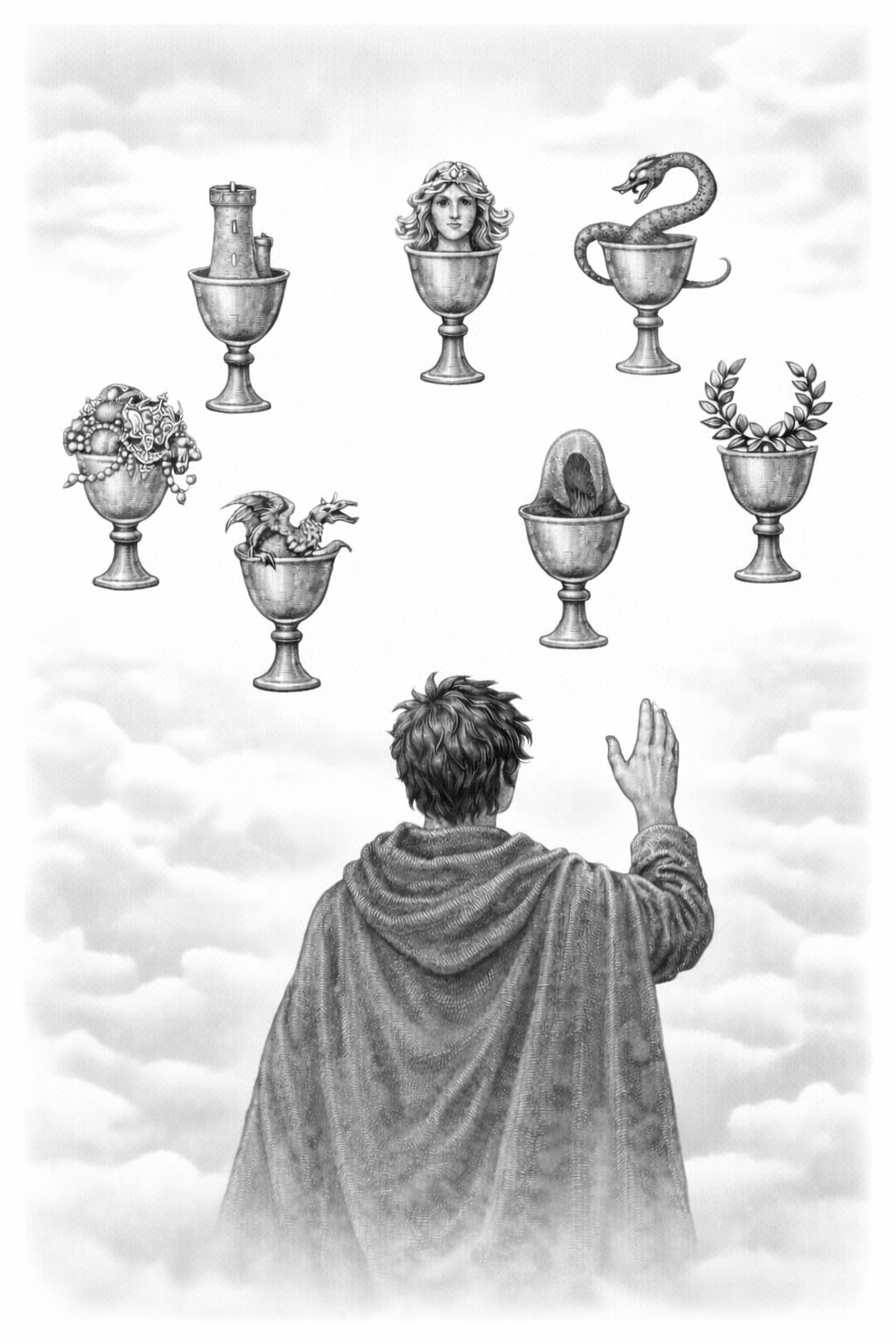
Cup Seven (Seven of Cups) often represents a field of possibilities, fantasies, and choices rather than a single clear path. In traditional imagery the card shows multiple cups, each containing a different image or symbol; this arrangement points to the mind’s capacity to imagine many different futures, desires, or temptations at once. As a card of the day, it highlights a tendency to be attracted to options that appeal emotionally or imaginatively, and it brings attention to how imagination, wishful thinking, and doubt can interact when decisions are required. Analytically, the card emphasizes the cognitive process of selection: evaluating alternatives, distinguishing meaningful opportunities from mirages, and recognizing where emotional longing may color perception. It also draws attention to internal conflicts between what is desirable and what is practical, and to the potential for decision paralysis when possibilities multiply. Psychologically, Cup Seven can point to rich inner life, creativity, and the value of brainstorming, while simultaneously signaling the need for criteria that separate viable choices from distractions or illusions. For daily reflection, consider examining which options are speculative versus grounded, what unconscious desires might be shaping attraction to certain outcomes, and what criteria could clarify priorities. The card suggests tempering imagination with discernment: allow creative exploration, but pair it with focused assessment to translate possibility into constructive action. In this way, Cup Seven functions as a prompt to balance openness to potential with sober appraisal, reducing confusion and supporting clearer decision-making.

Cup Seven

meaning.forward

The Seven of Cups, upright, describes a mental and emotional landscape characterized by multiplicity and ambiguity. It points to a situation where many options, wishes, or fantasies present themselves simultaneously, creating a sense of wonder but also confusion. Symbolically this card contrasts imagination with reality: some possibilities are genuine and constructive, others are alluring illusions or projections of desire. The image invites careful differentiation between what is substantive and what is merely tempting appearance. Psychologically, the card highlights the workings of desire, wishful thinking, and the tendency to idealize outcomes. It can indicate difficulty committing because the mind keeps opening new doors, or a retreat into fantasy to avoid making a concrete choice. At the same time, it acknowledges a fertile inner world and creative potential; the multiplicity of cups can be a resource for vision and innovation if channeled with discipline. Interpretively, the card encourages methods of discernment and grounding. Criteria, evidence, and values become important tools for evaluating options; practical testing and sequential commitment can help turn promising images into real outcomes. As an analytical prompt, the Seven of Cups asks the querent to clarify priorities, distinguish between long-term goods and seductive distractions, and transform vivid imagination into actionable plans rather than getting lost in possibilities.

meaning.reverse

When the Seven of Cups appears reversed, it signals a shift in the dynamics of imagination, choice, and emotional projection. Upright, the card emphasizes a profusion of options, fantasies, and temptation; reversed, it typically points toward either a clearing away of illusions or a consolidation of confusion into a more narrowed state. Psychologically, this position can indicate a move from idealization toward a more realistic appraisal of possibilities, or alternatively the collapse of options into indecision or avoidance. In practical terms, the reversed Seven of Cups often highlights the need to prioritize and to bring inner clarity to emotional and value-driven decisions. It can reveal an emerging capacity to distinguish between what is meaningful and what is merely alluring, or it can reflect stubborn wishful thinking that resists grounding. Attention to cognitive biases, emotional needs, and the consequences of scattering effort helps clarify which interpretation fits a given situation. Context matters: in relationship inquiries it may point to a choice being made or to confusion about commitments; in creative or career contexts it can mark either focus and follow-through or paralysis by too many deferred options. Working constructively with this energy involves examining motives, seeking factual information, and testing assumptions rather than indulging fantasies. Small, evidence-based steps and clear criteria for decision-making help translate inner clarity into outward action. If the reversed card appears alongside signs of withdrawal or avoidance, it can be useful to consider whether fear of making the “wrong” choice is preventing engagement; if it appears with indicators of emerging realism, it can be seen as a prompt to allocate resources to the option that best aligns with stated values.

meaning.love

The Seven of Cups in a love context points to the realm of imagination, options and emotional ambiguity. It highlights a tendency to be dazzled by possibilities, to project fantasies onto partners or potential partners, or to feel overwhelmed by choices without a clear sense of what is actually available versus what is wished for. Rather than describing outcomes, this card characterizes a psychological state: attraction to the ideal, difficulty distinguishing substance from allure, and a risk of indecision or avoidance through daydreaming. In an existing relationship the card can indicate that one or both partners are caught up in fantasies or distractions—romanticizing the past, imagining an alternate partner, or entertaining temptations—so that practical needs and honest communication get sidelined. For someone not partnered, it often marks a period when many options or imagined scenarios exist, but few are grounded in reality; choices may be postponed because none align clearly with personal values or long-term priorities. Analytically, the Seven of Cups invites examination of criteria for a satisfying relationship: which attractions are rooted in compatibility and shared goals, and which are emotional mirages? It encourages clarifying desires, distinguishing emotional impulse from sustainable commitment, and testing options against concrete information rather than wishful thinking. Questions to explore include whether attractions are projections, what trade-offs each option entails, and what emotional needs are driving the fantasizing. The card is useful as a prompt for discernment and for bringing imagination into balance with practical decision-making and honest communication.

meaning.job

In a career context, the Seven of Cups emphasizes a landscape of options, imagination and ambiguity rather than a single clear path. It points to a situation where many proposals, roles or ideas present themselves, some inspiring and creative, others illusory or insufficiently grounded. The card invites analytical separation of fantasy from feasible opportunity: assess each option against concrete criteria such as skills required, measurable outcomes, timelines, and risks rather than relying on wishful thinking or attractive narratives. It also highlights how indecision or scattering attention across too many possibilities can slow progress; narrowing focus by prioritizing what aligns with long‑term goals and core values helps convert potential into tangible results. At the same time, the Seven of Cups acknowledges the value of imagination and experimentation—creative options can be cultivated—but they benefit from disciplined evaluation, small tests or pilot projects, and verification of claims before major commitments. In practical terms, this card encourages gathering relevant facts, seeking outside perspectives to counter bias, defining clear selection criteria, and translating promising ideas into specific, time‑bound steps so career choices are informed, manageable and aligned with professional objectives.

meaning.finance

In a financial context, the Seven of Cups highlights a scene of many possibilities, options and fantasies rather than a single clear path. It suggests that choices are abundant but not all of them are realistic or well-founded. Emotion, desire and imagination may be inflating perceived opportunities; some offers may be attractive on the surface but lack substance, while others require careful vetting. The card points to the risk of scattering attention across too many ventures, chasing high-reward illusions, or making decisions based on wishful thinking rather than concrete information. Analytically, this card encourages examination of criteria and priorities: clarify which options align with long-term goals, assess feasibility and evidence, and separate imaginative scenarios from verifiable facts. It also highlights cognitive biases — such as optimism bias or fear of missing out — that can distort evaluation. In practice, useful steps include collecting reliable data, comparing costs and benefits, testing assumptions, and consulting knowledgeable sources. The Seven of Cups can also signal creative opportunity if imagination is tempered by discipline: channeling ideas into a structured plan can transform attractive visions into viable projects. Overall, it is a prompt to slow down, evaluate options critically, and choose with informed criteria rather than impulse.

meaning.family

Cup Seven (Seven of Cups) represents a field of possibilities, illusions and emotional choices. In the imagery of the card different cups present alluring but varied visions—some attractive, some dangerous, some clearly impractical. As a symbolic map of the inner life, it points to imagination, wishful thinking, and the difficulty of distinguishing what is desirable from what is real. In the family context, the card highlights situations in which multiple options or conflicting fantasies shape behavior and expectations. It can signify that family members are imagining different versions of home life, parenting, roles, or future plans without a shared grounding in practical realities. These divergent wishes can produce confusion, disappointment, or evasive behavior when choices need to be made. Alternatively, the card can indicate that someone in the family is escaping into idealized scenarios—romanticizing a past role, expecting others to fulfill imagined needs, or resisting concrete responsibilities by dwelling in imagined alternatives. Analytically, the card invites attention to the process of discernment. It is less about which choice is “right” and more about distinguishing between realistic options and fantasies that are unlikely to be sustained. Questions worth exploring include what criteria are being used to evaluate possibilities, whose expectations are driving decisions, and which hopes are based on concrete resources and mutual consent. Emotional appeals, wishful thinking, or attractions to novelty can be influential but should be weighed against long-term consequences and practical constraints. Applied to family dynamics, the card suggests the value of clear communication and shared criteria for decision-making: naming priorities, clarifying responsibilities, and testing options against everyday realities. It also calls for awareness of avoidance patterns—using imagination to postpone difficult conversations or to mask dissatisfaction—and for attending to the emotions underlying fantasies, since de

meaning.mind

When the Seven of Cups appears in the context of psychological state, it points to a mind caught between imagination and reality. The image traditionally shows multiple choices or visions, and psychologically this translates into a heightened inner landscape of possibilities, fantasies, and "what if" scenarios. Thought processes may be rich, associative, and creative, but also scattered, making it difficult to distinguish feasible options from wishful thinking or illusion. Attention can flip rapidly from one idea to another without settling, producing a sense of overwhelm or paralysis around decision-making. This card often reflects underlying mechanisms such as avoidance, projection, and idealization. Faced with ambiguity or pressure, the psyche may retreat into imagined outcomes or future scenarios that feel safer than confronting concrete constraints. Alternatively, it can reveal a tendency to inflate the positive potential of choices while minimizing practical drawbacks. Emotional investment may attach to images or narratives rather than to grounded evidence, so expectations can be unstable and disappointment more likely when fantasies meet reality. There is also a productive dimension: an active imaginative faculty that, when harnessed, supports creativity, planning, and visioning. The psychological task suggested by this card involves developing discrimination and clarity within an abundant inner landscape. Techniques that support differentiation between imagination and reality—such as reality-testing, prioritizing according to values, slowing down the decision process to gather information, and trying small experiments rather than committing to large, irreversible steps—are relevant frameworks for understanding how this mental state operates. In clinical or self-reflective terms, exploring the roots of avoidance, assessing fear of loss versus fear of making a choice, and working to strengthen tolerance for ambiguity can transform diffuse possibility into actionable intent. Seen educationally, the Seven

meaning.soul

When the Seven of Cups appears as a description of emotional state, it characterizes a mind full of options, images and longings rather than clear, rooted feeling. Emotions are experienced as a series of possibilities—fantasies, hopes, fears and projections—that sparkle with attraction but lack defined edges. The inner landscape is fertile with imagination and wishful scenarios, yet this abundance can produce confusion, indecision and a tendency to mistake desire for reality. Distinguishing what is genuinely felt from what is wished for becomes the central task; emotions may be inflated by idealization or deflated by avoidance, and attachments may form to imagined outcomes rather than to present relationships or facts. This state also highlights the psychological cost of too many choices. When attention is scattered among many appealing visions, it becomes difficult to commit, prioritize or assess consequences. Conversely, the same mental looseness can be a source of creativity, enabling exploration of new feelings and solutions that more literal thinking would bypass. Analytically, the card points to the need for criteria and testing: clarifying values, examining evidence, and grounding impressions in small, observable actions can help separate constructive imagination from escapism. Emotionally, it signals a moment for developing discernment—learning to translate inner images into viable intentions by narrowing focus, checking assumptions, and acknowledging which options are projections of fear or wishful thinking.